
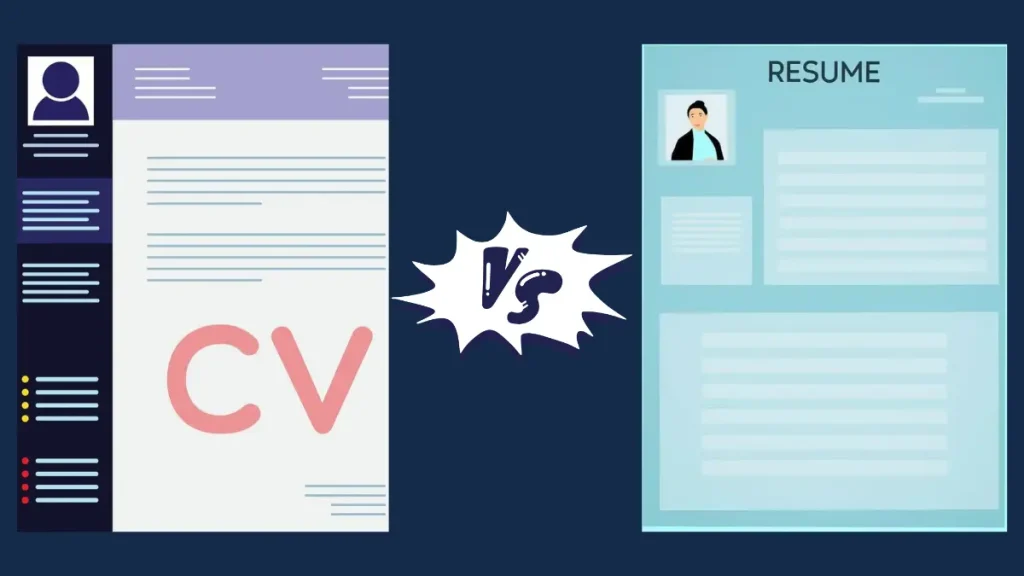
If you are applying for a job in the United States, you may wonder whether you need a CV or a resume. Both documents explain your qualifications, education, skills, and experience, but they serve different purposes in the American job market.
The main difference between a CV and a resume is their purpose and level of detail. A resume focuses on the skills, experience, and qualifications that best match a particular job. A CV, on the other hand, gives a broader overview of your educational background, work history, and professional accomplishments.
In this guide, you will learn what is a CV vs resume mean, whether they are the same, the key differences between them, and when to use each document for a job application in the United States.
Table of Contents
What Is a Resume?
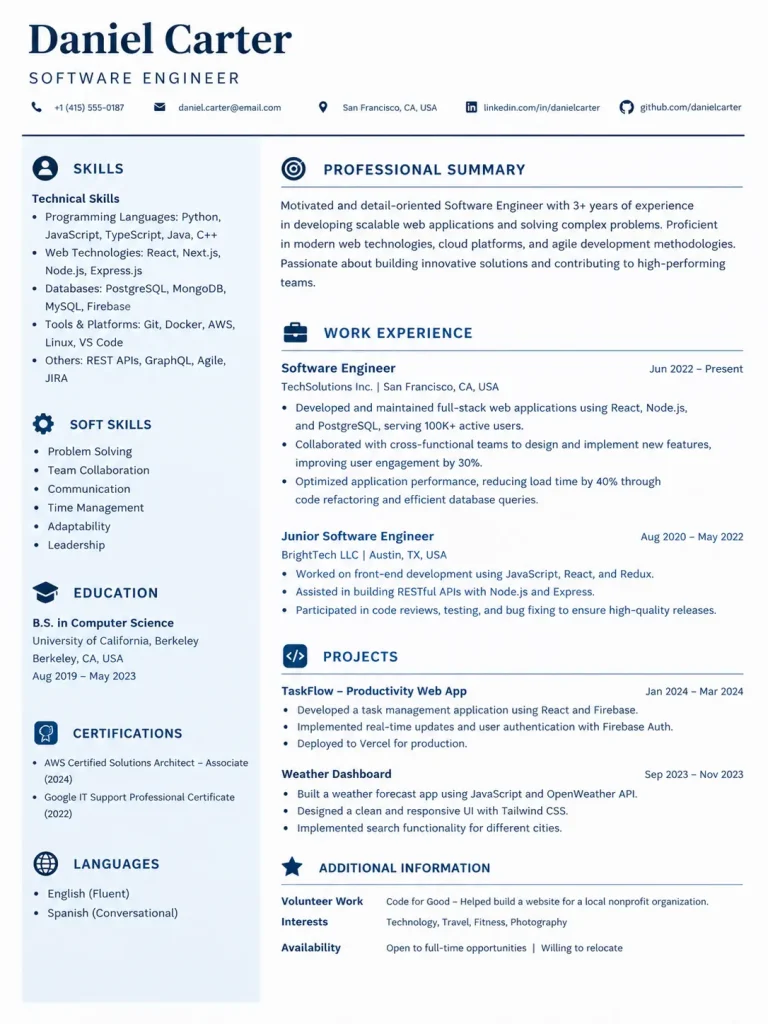
A resume is a short, job-focused document that summarizes your relevant work experience, education, skills, and accomplishments. Employers use it to understand whether your qualifications match the position they are hiring for.
In the United States, a resume is the standard document for most nonacademic jobs, including positions in business, technology, retail, hospitality, marketing, and customer service.
A resume usually includes:
- Contact information: Your name, phone number, professional email address, and relevant professional links.
- Professional summary: A short introduction highlighting your experience and strongest qualifications, if useful.
- Work experience: Your previous jobs, responsibilities, and measurable achievements.
- Education: Your degrees, schools, and relevant qualifications.
- Skills: Abilities that match the job description.
- Certifications and projects: Relevant additional qualifications, when applicable.
How Long Should a Resume Be?
For many applicants, a one-page resume is a good starting point. A two-page resume can also be appropriate when you have substantial relevant experience or qualifications to include.
Instead of focusing only on length, make sure your resume includes the information employers need to evaluate your qualifications. Instead, include the information an employer needs to evaluate your fit for the position.
For example, if you are applying for a customer service job, emphasize communication, problem-solving, and customer support experience rather than unrelated details.
For additional guidance on writing a professional resume for job applications in the United States, check out the Harvard College Guide to Creating a Strong Resume. It covers resume formatting, writing tips, common mistakes, action verbs, and sample resumes.
What Is a CV (Curriculum Vitae)?
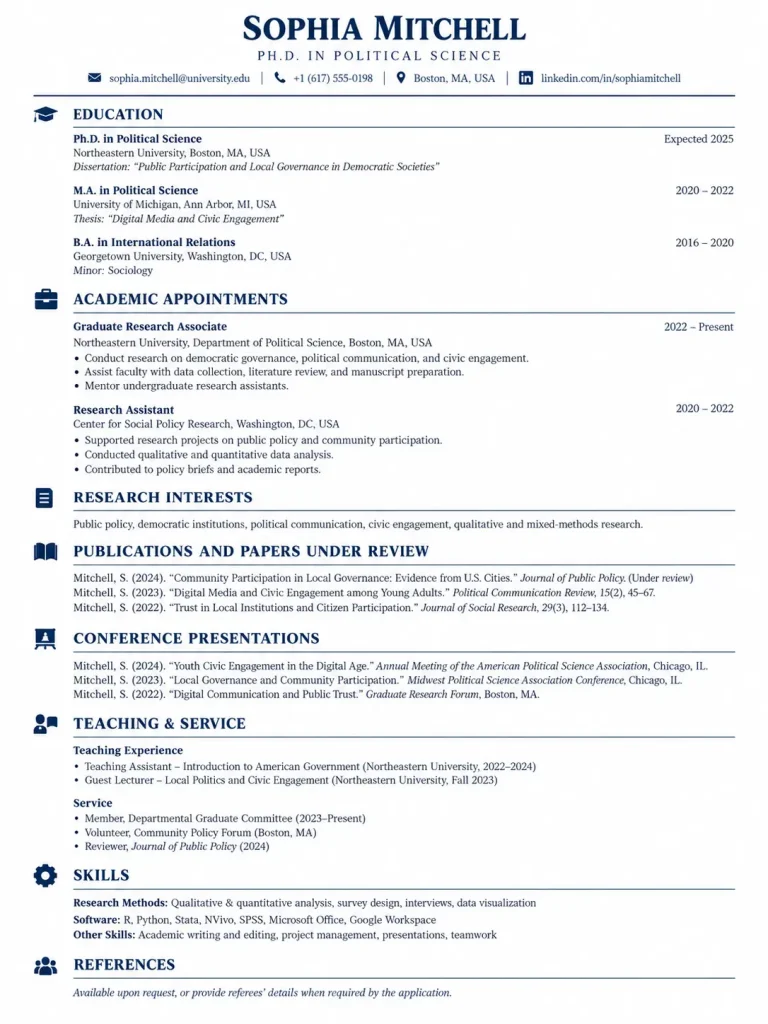
CV stands for curriculum vitae, a Latin phrase meaning “course of life.” In the United States, a CV is generally a detailed document describing your academic background, research, professional experience, and achievements.
A CV is commonly used when applying for academic positions, research opportunities, university teaching roles, fellowships, and certain medical or scientific positions.
Depending on your field and experience, a CV may include:
- Contact information
- Education and academic qualifications
- Research experience and interests
- Publications and scholarly articles
- Teaching experience
- Conference presentations
- Grants, fellowships, and awards
- Professional memberships
- Relevant certifications and other achievements
How Long Should a CV Be?
Unlike a standard resume, an academic CV does not have a universal page limit. Its length depends on your experience, achievements, field, and the institution’s requirements.
An early-career researcher may have a relatively short CV, while an experienced professor with numerous publications and presentations may need several pages.
The purpose of a CV is to present a complete and relevant record of your academic and professional accomplishments, not to fit everything onto one page.
If you want to create a professional CV or resume, you can use Canva to choose and customize a template.
What Is the Difference Between a CV and a Resume?
The four key differences between a CV and a resume are their purpose, content, length, and common use.
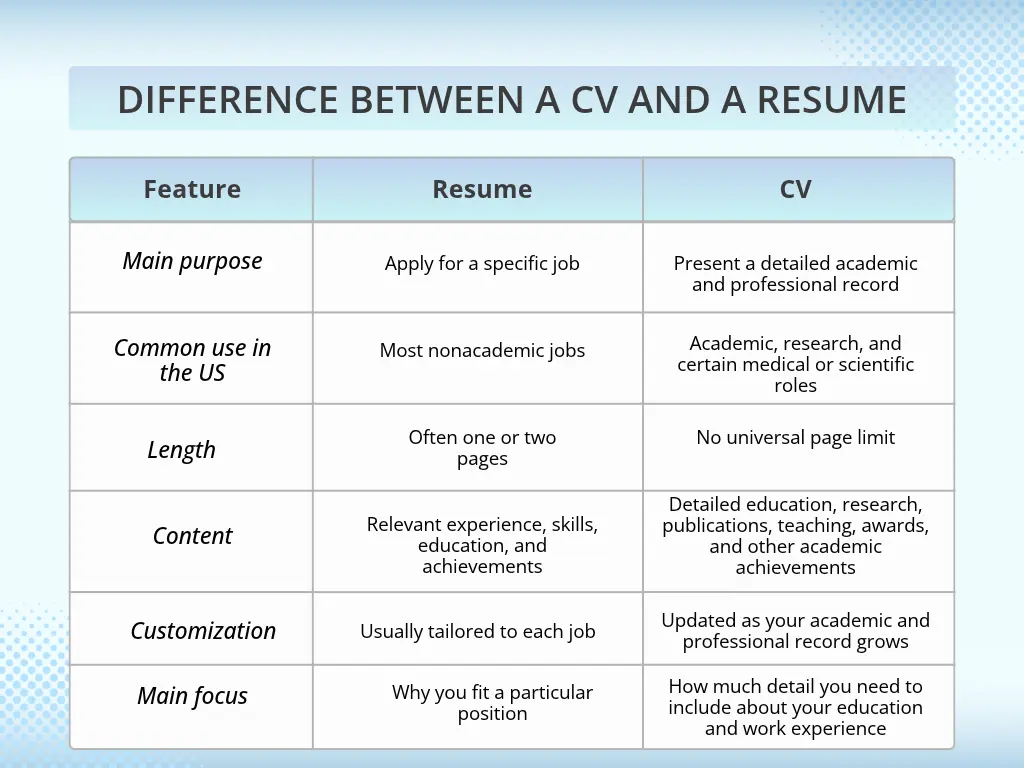
Remember: These are general differences in the United States. Some employers and industries use the terms differently, so always follow the instructions in the job posting.
For more detailed guidance on creating an academic CV, you can explore the Harvard Griffin GSAS CV & Cover Letter Guide. It provides useful information about academic CV sections, formatting, and examples.
CV vs Resume: Which One Should You Use in the United States?

Choosing between a CV and a resume depends mainly on the position you want and the document requested by the employer.
Use a Resume When Applying for Most Jobs
A resume is generally the right choice for positions such as:
- Software developer
- Accountant
- Marketing specialist
- Customer service representative
- Sales associate
- Barista or restaurant worker
- Administrative assistant
- Business analyst
For these positions, employers usually want a clear summary of your relevant skills, experience, and achievements.
For example, if you are applying for a marketing specialist position, your resume should highlight relevant campaigns, marketing tools, results, and communication skills.
Use a CV for Academic and Research Positions
A CV is often appropriate for roles such as:
- University professor
- Academic researcher
- Research scientist
- University lecturer
- Certain medical or scientific positions
- Applicants seeking academic fellowships or research grants
These opportunities may require detailed information about your education, research projects, publications, teaching experience, and academic achievements.
For example, if you are applying for a university research position, your publications and research experience may be more important than a short summary of unrelated work experience.
Important: Some institutions have their own application requirements. Check the job advertisement or official application instructions before submitting either document.
CV vs Resume Example
The following examples show how the same fictional candidate might present their qualifications differently depending on the position.
Example 1: Resume for a Business Job
Alex Morgan
Austin, TX | alex.morgan@example.com | LinkedIn: linkedin.com/in/example
Professional Summary
Customer service professional with three years of experience helping customers, resolving issues, and supporting daily business operations.
Work Experience
Customer Service Representative
Example Retail Company | 2023–Present
- Respond to customer questions through email and phone.
- Resolve routine service issues and explain company policies.
- Maintain accurate customer records and follow up on outstanding requests.
Education
Bachelor of Business Administration
Example University | 2022
Skills
Customer service, communication, problem-solving, Microsoft Excel, and record management.
Example 2: CV for an Academic Position
Alex Morgan
Austin, TX | alex.morgan@example.com
Education
- PhD in Biology, Example University, 2025
- MS in Biology, Example University, 2021
Research Experience
Graduate Researcher, Example University | 2021–2025
- Conducted research on a defined biological topic.
- Collected and analyzed research data.
- Prepared research findings for academic presentations.
Publications
- Morgan, A. (2025). Example Research Title. Example Journal.
Teaching Experience
Teaching Assistant, Example University | 2022–2024
- Assisted with undergraduate laboratory sessions.
- Supported students with course assignments.
Is a CV the Same as a Resume?
Not always. In the United States, a CV and a resume generally refer to different documents, especially in academic and nonacademic hiring.
However, the terminology varies by country. In the UK and many other countries, a CV is commonly used when applying for jobs, much like a resume in the United States.
This difference can cause confusion when applying for jobs internationally. Always check what the employer means by CV or resume instead of assuming the terms are interchangeable.
CV vs Resume in the USA and UK
The meaning of a CV can vary depending on the country. In the United States and the United Kingdom, employers use the terms CV and resume differently.
In the United States
In the USA, a resume is the standard document used when applying for most jobs. It is usually one or two pages long and highlights relevant work experience, education, and skills.
A CV (Curriculum Vitae), on the other hand, is generally used for academic, research, scientific, and medical positions. It provides a detailed record of a person’s education, publications, research, teaching experience, and professional achievements. Unlike a resume, an academic CV can be several pages long.
In the United Kingdom
In the UK, a CV is the standard document used when applying for most jobs. It is similar to a US resume because it summarizes a person’s education, work experience, skills, and qualifications.
The term “resume” is less commonly used in the UK for regular job applications. For academic and research positions, applicants may need a more detailed academic CV.
Key Difference
The main difference is how employers use these terms. In the USA, a resume is commonly used for regular jobs, while a CV is mainly used for academic and research positions. In the UK, a CV is commonly used for most job applications.
What Is the Difference Between a CV, Resume, and Biodata?
A CV, resume, and biodata are related documents, but their purposes can differ.
- Resume: A job-focused summary of your relevant qualifications, work experience, and skills.
- CV: In the US, a detailed academic and professional record, commonly used for academic and research applications.
- Biodata: A personal-information document that may include biographical details alongside education and work history. Its format and purpose vary by country and context.
In the United States, employers generally expect a resume for most regular job applications. A biodata document is not a standard replacement for a resume unless the employer specifically requests it.
Tips for Choosing the Right Document
Before submitting a CV or resume, follow these practical steps:
- Read the job description. Check whether the employer specifically requests a resume or a CV.
- Consider the type of position. Most nonacademic roles use resumes, while academic and research positions often require CVs.
- Highlight relevant information. Put the most important qualifications where the reader can find them quickly.
- Use a clear format. Choose readable fonts, consistent headings, and simple formatting.
- Check your details. Verify dates, contact information, spelling, and the accuracy of every qualification.
- Follow the application instructions. If the employer provides a template, page limit, or specific submission format, follow it.
Related Guide: If you want to learn how to make a resume with no work experience, read our complete guide.
Frequently Asked Questions
1. What is a CV vs. resume?
In the United States, a resume is usually a concise summary of qualifications for a specific job, while a CV is a more detailed record of academic and professional achievements, commonly used for academic and research positions.
2. What is the difference between a CV and a resume?
The main differences are purpose, length, and content. A resume highlights relevant qualifications for a particular job, whereas an academic CV documents education, research, publications, teaching, and other achievements in greater detail.
3. Is a CV better than a resume?
Neither document is universally better. The right choice depends on the position and the employer’s instructions. Before applying, check the employer’s instructions to make sure you submit the correct type of document.
4. Can I use a resume instead of a CV?
For many nonacademic US jobs, a resume is appropriate. However, if a university, research institution, or other employer specifically requests an academic CV, submit a CV that meets its requirements.
5. Can a resume be two pages long?
Yes. A one-page resume is often suitable for early-career applicants, but two pages can be appropriate for candidates with substantial relevant experience. Keep the information focused on the position.
6. Do US employers use CVs?
Yes. US employers and institutions use CVs for many academic, research, fellowship, and certain medical or scientific applications. In the US, a resume is the usual document for applying to most jobs outside academic and research fields.
7. Should I include a photo on a US resume?
For most jobs in the United States, leave your photo off your resume unless the employer specifically asks you to include one. Also avoid unnecessary personal details such as age and marital status.
8. What does CV stand for?
CV stands for curriculum vitae, a Latin phrase meaning “course of life.”
Conclusion
Understanding the difference between a CV and a resume helps you prepare the right document for your job application. In the United States, a resume is generally used for most nonacademic jobs, while a CV is commonly used for academic, research, and certain specialized positions.
Before applying, review the job posting, choose the document that matches the employer’s requirements, and present your qualifications clearly and accurately. A well-organized application makes it easier for employers to understand your experience and assess whether you are suitable for the role.
The most important rule is simple: follow the employer’s instructions and submit the document they request.
Pingback: How to Make a Resume With No Work Experience: 7 Easy Tips
Pingback: How to Activate Mobile Banking: 6 Easy Steps (2026)